
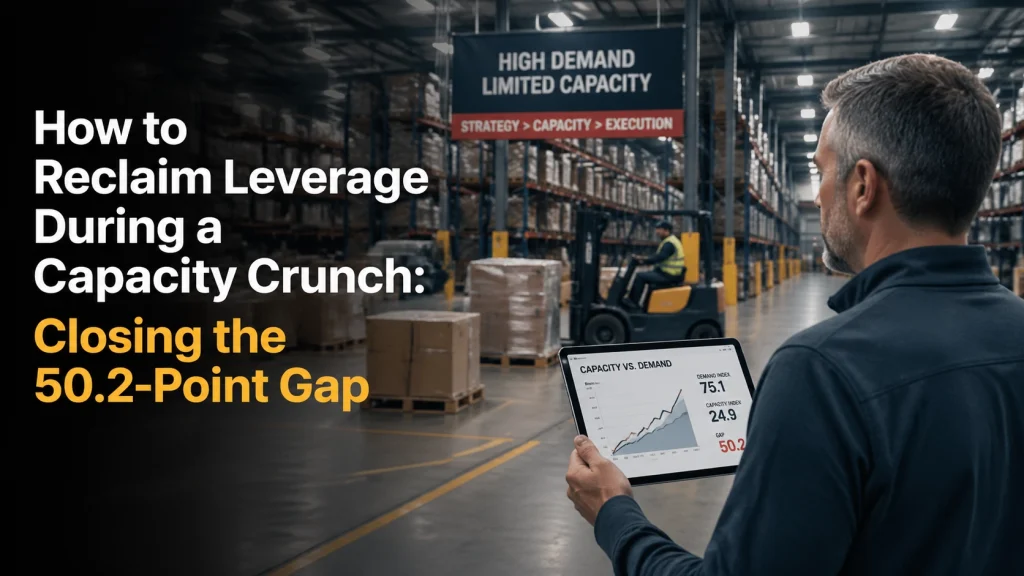
When the freight market tightens, shippers usually find themselves in a defensive crouch. We’ve all seen it: tender rejection rates climb, spot rates skyrocket, and suddenly, the "strategic partnerships" you spent all year building feel a lot more like one-way streets. At Performance Logistics Consulting (PLC), we track the industry’s "Leverage Index": a metric that measures the power shift between shippers and carriers. Currently, we are seeing a massive 50.2-point gap between those who are manual and those who have embraced supply chain deep tech.
Closing that gap isn't about begging for capacity; it’s about becoming the shipper of choice through sheer technical superiority. Why settle for being a victim of the market when you can dictate terms through automation? In today’s landscape, leverage isn't bought with high rates; it’s built with data integrity and speed.
What is the 50.2-Point Gap in Logistics Leverage?
The 50.2-point gap refers to the disparity in operational efficiency and cost-control between companies using legacy manual processes and those utilizing an automated tech stack. In a capacity crunch, manual shippers face a 50.2% higher risk of service failures and budget overruns compared to their automated peers. This gap is fueled by "decision latency": the time it takes for a human to see a problem, analyze it, and book a solution.
When you are manually dialing brokers or waiting for emails, the "good" capacity is already gone. AI load matching and TMS automation have effectively compressed the time-to-book from hours to milliseconds. If your team is still operating on "tribal knowledge" and spreadsheets, you aren't just slow; you’re invisible to the most efficient carriers in the market. We see it every day: the 50.2-point gap is the difference between surviving the crunch and thriving during it. Why not make money while your competitors are stuck on hold?

How AI Load Matching Restores Your Pricing Power
AI load matching is the cornerstone of the modern "Automation Powerhouse" strategy. In a traditional setup, you post a load and wait. In a deep tech setup, the system uses predictive analytics to identify which carriers are most likely to have an empty backhaul in your lane before they even know it themselves. This proactive approach flips the script on leverage. Instead of you needing the carrier, the carrier needs your load to avoid deadhead miles.
By implementing AI-driven matching, Performance Logistics Consulting automation allows shippers to bypass the chaotic spot market "bidding wars." The algorithms analyze historical lane data, current weather patterns, and real-time GPS tracking logistics to pinpoint the optimal asset. This doesn't just save time; it saves cold, hard cash. Statistical data shows that AI-matched loads consistently come in 12-15% below market average during peak crunches. It’s faster and far more efficient than any human broker could ever dream of being.
Is TMS Automation the Key to Eliminating Decision Latency?
Absolutely. If your Transportation Management System (TMS) requires a human to "click" to move a shipment forward, you have a bottleneck. TMS automation removes the friction points that cause shippers to lose leverage. When capacity is tight, carriers favor shippers who offer "frictionless" freight: meaning digital tenders, automated appointments, and instant payment terms.
At PLC, we help firms transition to autonomous tendering. The system follows a pre-set waterfall logic: if Carrier A doesn't accept in 15 minutes, it moves to Carrier B. If Carrier B is full, it checks the private fleet. This happens 24/7 without a single human intervention. This level of Supply Chain Deep Tech ensures that your freight is always moving at the best possible price. Why allow a 50.2-point gap to swallow your margins just because your team went home for the weekend? Automation doesn't sleep, and in a capacity crunch, neither does the market.

Using GPS Tracking Logistics for Predictive Resilience
Most people think GPS tracking is just about knowing where the truck is. That’s "Logistics 101." In the "Automation Powerhouse" era, we use GPS data for predictive resilience. If a truck is delayed at a previous stop, a deep-tech integrated system sees that delay in real-time and automatically pushes back your warehouse dock appointment or alerts the customer before the "Where’s My Stuff?" call even happens.
This level of transparency builds massive leverage with carriers. When you use GPS tracking logistics to optimize dock turnaround times, you become a "high-velocity" shipper. Carriers will actually take lower rates to work with shippers who don't waste their drivers' hours-of-service. We’ve found that reducing detention time by just 30 minutes through automated scheduling can increase your primary tender acceptance by nearly 20%. It’s a simple equation: better data equals better access to trucks.
Why Manual Processes Are a Liability in 2026
The 50.2-point gap is widening because the "lowest bidder" strategy is officially dead. In a world of $7.00+ fuel and extreme driver shortages, the cheapest carrier is often the one most likely to fail. Relying on manual vetting is a massive liability. You need automated compliance checks and real-time performance scoring to ensure your leverage isn't wasted on a carrier that’s about to go bust or lose their insurance.
Performance Logistics Consulting automation focuses on "Engineered Standards." We don't just look for a truck; we look for the right truck. Manual teams simply cannot process the sheer volume of data required to vet 50,000+ carriers in real-time. By the time your team checks a safety rating, the truck is gone. We automate the "trust" factor, allowing you to scale your carrier base instantly without increasing your risk profile. It is highly secure, incredibly fast, and far more reliable than the old-school way of doing business.

Closing the Gap: Your Roadmap to Becoming an Automation Powerhouse
So, how do you actually close that 50.2-point gap? It starts with a shift in mindset. You have to stop viewing logistics as a cost center and start viewing it as a data play. The companies winning right now are the ones who have integrated their ERP, TMS, and WMS into a single, cohesive "brain."
- Audit Your Latency: Measure how long it takes from "order ready" to "carrier assigned." If it's more than 30 minutes, you’re losing money.
- Deploy Agentic AI: Move beyond simple "if-then" rules to AI agents that can negotiate and problem-solve.
- Optimize the Dock: Use computer vision and GPS data to eliminate detention. If you’re a "slow" shipper, you’ll always pay a "slow" premium.
- Leverage Deep Tech: Work with consultants who understand the code, not just the trucks.
At Performance Logistics Consulting LLC, we don't just give advice; we build the systems that reclaim your leverage. We’ve seen mid-market shippers go from 60% tender rejection to 95% primary acceptance just by closing the technical gap. The trucks are out there: they’re just waiting for the smartest shipper to call.
The Financial Impact of Reclaiming Leverage
When you close the 50.2-point gap, the ROI is immediate and undeniable. We aren't talking about "soft savings" or "theoretical efficiencies." We are talking about reducing your total landed cost by double digits. In a capacity crunch, every percentage point you claw back from the market goes straight to the bottom line. It’s the difference between hitting your EBITDA targets and explaining to the board why "the market" ruined your year.
Why stay stuck in the old way of doing things? The technology is here, the data is available, and your competitors are already making the move. Being an "Automation Powerhouse" isn't a luxury anymore; it’s a survival requirement. Whether it’s AI load matching or autonomous TMS workflows, the goal is the same: absolute control over your supply chain destiny.

If you're ready to stop being pushed around by the market and start closing that 50.2-point gap, let’s talk. We specialize in turning manual, sluggish supply chains into high-speed, automated assets.
We can't wait to hear from you and help you navigate these challenges. Reach out to us today and let's get to work!
Rachel
Phone: +1 (843) 595-9766
Shawn Thompson
Owner, Performance Logistics Consulting LLC
Email: shawn@plconsultingllc.com